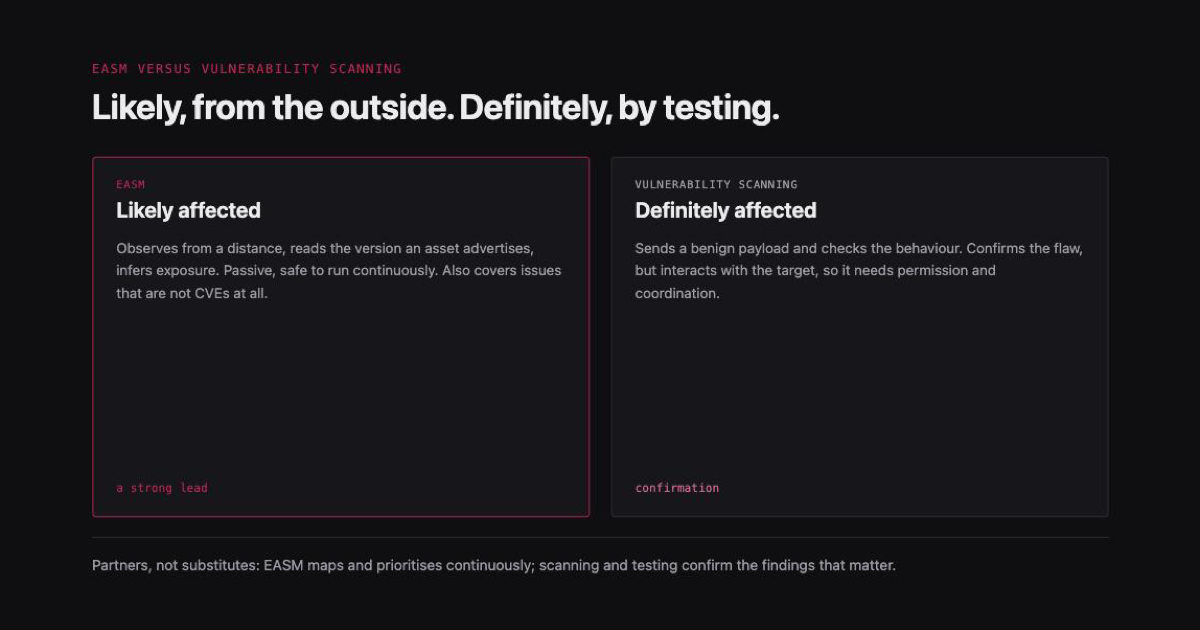
One distinction causes more confusion in this field than any other, and getting it wrong leads organisations to buy the wrong thing or to trust a finding they should have verified. It is the difference between External Attack Surface Management and vulnerability scanning. They overlap, they are often sold together, and they answer genuinely different questions. The NCSC puts the distinction more crisply than most: EASM tells you a system is likely affected by a known vulnerability. A vulnerability scanner tells you whether it is definitely affected.
Likely, from the Outside
EASM works at a distance and without touching the target in any intrusive way. It observes an asset, identifies the software and version it appears to be running, and cross-references that against known vulnerabilities. If it sees a web server reporting a version that has a published flaw, it flags the asset as likely affected. It has not tested the flaw. It has inferred exposure from what the asset advertises about itself.
That inference is useful and cheap, but it is an inference. Version banners can be wrong or deliberately misleading. A vulnerability may require a specific configuration the asset does not have. A patch may have been backported without changing the version string. So an EASM finding of “likely vulnerable” is a strong lead, not a confirmed fact, and treating it as confirmed is a common mistake.
Definitely, by Testing
A vulnerability scanner goes a step further. It sends a benign payload designed to confirm whether the flaw is actually present and exploitable, then reads the response. It is not inferring from a banner; it is checking the behaviour. That gives a much more definite answer, at the cost of being an active interaction with the target rather than a passive observation.
That cost matters. Active scanning can trip intrusion detection systems, generate load, and in rare cases affect fragile services. It usually needs permission and coordination in a way that passive observation does not. This is why some EASM products offer vulnerability assessment only as an add-on that you switch on deliberately, and why the NCSC flags it as something to align with your security team before enabling.
Issues, Not Just Vulnerabilities
There is a second difference that gets less attention. A vulnerability scanner is built around known, catalogued vulnerabilities, the things with identifiers. EASM ranges wider, into what the NCSC prefers to call issues or risks rather than strictly vulnerabilities. An exposed database that should never have been public is not a CVE, but it is a serious problem. Missing email security records, a subdomain takeover risk, a service that has no business facing the internet, a certificate about to expire: none of these is a vulnerability in the narrow sense, and all of them are exactly what EASM is good at surfacing. Judged only as a vulnerability scanner, EASM looks weak. Judged as what it is, it covers ground a scanner never touches.
How They Fit Together
The two are complementary, and the sensible way to use them reflects that. EASM runs continuously and broadly, mapping the whole surface and flagging everything that looks likely or misconfigured. That output becomes a prioritised list of leads. Vulnerability scanning, and beyond it penetration testing, then confirms and explores the ones that matter, on the assets that warrant the deeper, more intrusive attention. EASM tells you where to look. The confirmation tools tell you what is really there. Neither replaces the other, and buying one while believing you have bought the other is how gaps open up.
The Short Version
EASM observes from the outside and tells you a system is likely affected by a known vulnerability; a vulnerability scanner tests actively and tells you whether it definitely is. EASM also covers issues that are not vulnerabilities at all, like exposed services and weak email security, which a scanner ignores. Use EASM to map continuously and prioritise, and use scanning and testing to confirm the findings that matter. They are partners, not substitutes.