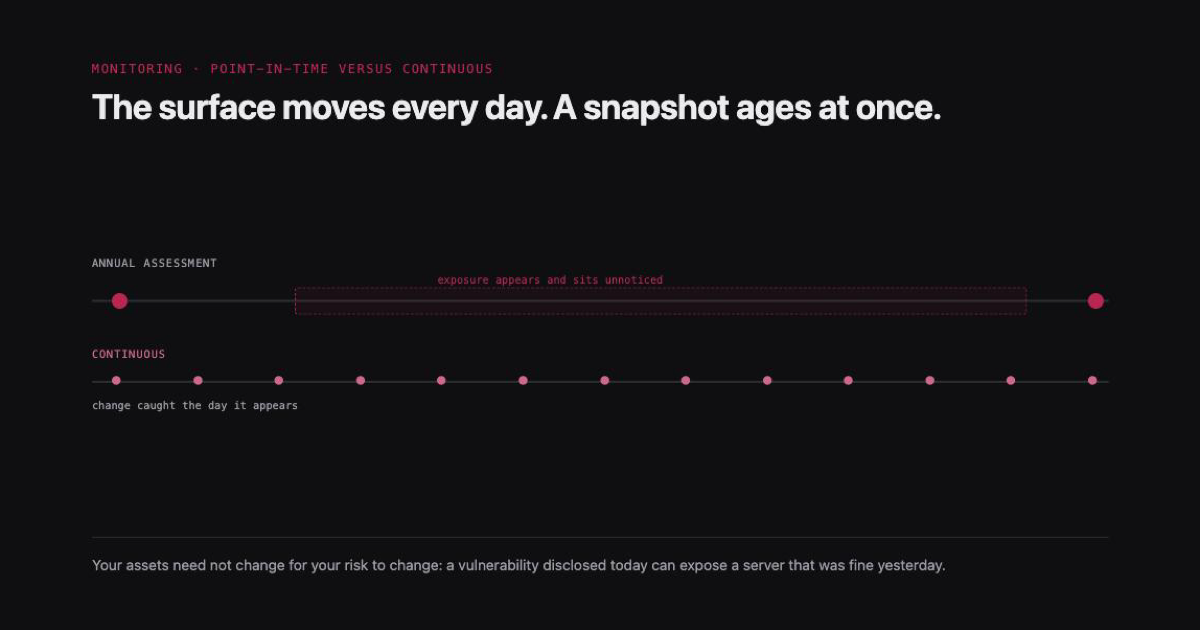
The word that does the quiet work in “external attack surface management” is management, and management means continuously, not once. A great deal of security is still bought and delivered as a point-in-time exercise: the annual penetration test, the quarterly scan, the assessment before a big launch. Those have their place, but for the external attack surface they answer a question that goes stale almost as soon as it is asked.
The Surface Moves Every Day
An external attack surface is not a fixed thing you can photograph. It changes constantly, and mostly without anyone deciding it should. A developer deploys a new service. A DNS record is added for a launch. A certificate expires. A cloud storage bucket is made public by a default setting. A supplier changes the script they serve. A new vulnerability is disclosed in software you have been running untouched for a year. None of these is a decision your security team made, and several of them create exposure the moment they happen.
Against a surface that moves like that, an annual assessment is a snapshot of a river. It was accurate at the instant it was taken and began drifting out of date immediately. The gap between one assessment and the next is a window in which new exposure appears and sits unnoticed, and attackers work in exactly that window.
What Continuous Actually Buys You
The value of continuous monitoring is not just fresher data. It is the ability to see change, which is a different and often more useful thing than seeing state. A monitored surface tells you not only what exists today but what appeared since yesterday, and that delta is where the signal is.
- A new subdomain appears that nobody logged: worth a look, today, not next quarter.
- A service that was closed is suddenly open: a firewall change or a misconfiguration, caught while it is fresh.
- A certificate is days from expiry: fixed before it takes a service down, not after.
- A newly disclosed vulnerability now matches software on an asset you already had: flagged the day the disclosure lands.
That last case is the one people underestimate. Your assets do not have to change for your risk to change. A vulnerability published today can turn a server that was fine yesterday into an exposure overnight, and only something watching continuously, and re-checking against current threat intelligence, will tell you.
The Thing to Watch: Alert Fatigue
Continuous monitoring has a failure mode, and it is human. A tool that reports every change equally will bury the two findings that matter under two hundred that do not, and a team that has learned to ignore its alerts is no better off than one with no tool at all. The point of monitoring is not the volume of what it reports but the prioritisation of it: surfacing the genuinely new and genuinely risky, and staying quiet about the routine. When you assess a product, how well it ranks and filters change is at least as important as how much it detects.
The Short Version
The external attack surface changes every day, usually without anyone deciding it should, so a point-in-time scan is out of date the moment it finishes. Continuous monitoring keeps the picture current and, more usefully, shows you what changed: the new subdomain, the newly open service, the expiring certificate, the freshly disclosed vulnerability that now matches something you already run. Its hardest problem is not detection but prioritisation, because a tool nobody listens to protects nobody.