A ticket lands on Monday morning: an external scan has flagged nginx 1.18.0 on a public web host, mapped it to a handful of CVEs, and marked it high. Nobody has touched that server. The patch went on three weeks ago. Welcome to the practical problem behind passive vs active vulnerability detection, which is not really a question about tooling at all, but about what a piece of evidence entitles you to claim.
Most explanations of this topic come from the network monitoring or OT world, where passive means a span port and a sensor that listens to traffic without injecting any. Useful, but not your situation. From outside the perimeter, looking at your own estate the way an attacker does, the distinction works differently, and the gaps between the two methods show up in specific places that cost real time.
What each method actually observes from outside your perimeter
Passive external detection reads what the internet already publishes about you. Certificate transparency logs record every certificate a public CA issues, so a new subdomain announces itself at the moment of issuance. DNS and WHOIS records say what resolves where and who registered it. HTTP response headers, service banners, TLS stack fingerprints and page content say what software is probably running. No request is sent that a target would consider unusual; much of it involves no contact with your systems at all, because the data is sitting in public logs and resolver caches.
Active detection sends something deliberate. A crafted request that triggers a distinguishing response, a version probe, an authenticated check against the package manager, a controlled proof-of-concept interaction that confirms one specific condition exists on one specific host. The output is different in kind: not a probability, but a demonstration.
Between the two sits discovery. Expanding outward from a seed domain through certificate logs, passive DNS, reverse WHOIS and ASN data gives you a candidate list, and a candidate list is an input, not an answer. Some of those hosts are yours. Some belong to an agency, a reseller or a company you bought four years ago. Working out which is which is the unglamorous middle step that asset discovery from the outside exists to feed, and skipping it is where most of the pain starts.
One point worth fixing early: external passive observation is not the same as passive network monitoring on an internal tap. Inside, passive means you see every packet and infer from traffic you did not generate. Outside, you see public artefacts and inferred software versions. The honest output is a ranked candidate with a confidence level attached. It has not tested the flaw.
Likely affected versus definitely affected
A banner is a claim made by software about itself. Nothing more. When a scanner reads Server: nginx/1.18.0 and matches it to a CVE list, it has produced an inference: if that string is accurate, and if the build is upstream, and if the vulnerable module is compiled in and reachable, then the host is probably affected. Three conditionals in one sentence. That is why the distinction between likely affected and definitely affected is the whole discipline in one line.
Back-ported patches are the single largest source of passive false positives on UK estates. Debian, Ubuntu and Red Hat maintain their own package branches: when a security fix lands upstream, the distribution applies the patch to the version it ships and bumps only the package revision, leaving the advertised version string alone. The server says 1.18.0 because it is, in upstream terms, still 1.18.0. The changelog says the flaw was fixed. Red Hat publishes this behaviour openly in its security pages, and Debian and Ubuntu do the same through their respective security trackers, so the information is there if someone goes and checks. Most teams do not have time to check twenty of them a week.
Then there is the edge. Reverse proxies, CDNs and WAFs rewrite, suppress or invent response headers as a matter of routine. The banner you read may describe a Cloudflare or an F5 in front of the application, not the origin running three hops behind it. Sometimes the header is removed entirely, which is good hygiene and terrible for inference, because absence of evidence gets recorded as a clean result.
Acting on inference alone has a cost in both directions. Treat every candidate as a finding and you spend change windows patching hosts that were already patched, and the team learns to distrust the feed. Treat none of them as findings and a genuinely exposed service sits there until somebody else notices it. Neither failure mode is theoretical.
Six gaps where passive and active detection give different answers
Gap 1: back-ported and vendor-maintained builds
Passive fingerprinting cannot see inside a package. An Ubuntu LTS host with a back-ported fix, a vendor appliance running a hardened fork, an application server bundled by a supplier with their own patch cadence: all three present a version string that lies by omission. Only an authenticated check, or an active probe for the specific defect, settles it. Rule: if the asset runs a distribution package or a vendor appliance, never close the ticket on the banner alone.
Gap 2: fronted and virtual-hosted services
Where a CDN, load balancer or WAF terminates the connection, the banner describes the edge. Virtual hosting compounds this, because one IP may serve forty names and respond differently to each depending on the Host header and SNI. Passive data tells you the edge is healthy. It tells you very little about the origin. Rule: for anything behind a proxy, the passive result describes the front door and nothing behind it.
Gap 3: assets you have not confirmed you own
This is the gap that is a legal question rather than a technical one. Discovery routinely surfaces hosts registered by a marketing agency, a reseller, a hosting partner or a former supplier who still has your brand in the CNAME chain. Probing those without written authorisation is a Computer Misuse Act 1990 problem, not a security one. Passive observation of public records remains available to you; active testing does not, until ownership is confirmed and permission is in writing. Rule: ownership gates active testing, and appetite does not override it.
Gap 4: timing and change
A certificate issued on a Tuesday afternoon for a new campaign subdomain appears in transparency logs within hours. A quarterly authenticated scan is deeper than any passive source, and it will miss that subdomain for up to three months. Change blindness is not a detection failure; it is a cadence failure, and it is the reason scan frequency should be tiered by asset rather than set once for everything. Rule: on fast-moving estate, cadence beats depth.
Gap 5: severity and reachability
A CVSS score describes a vulnerability in the abstract. It does not know whether the vulnerable path is reachable on your deployment, whether the affected endpoint sits behind authentication, whether the module is even loaded, or whether a mitigating configuration is already in place. Active verification answers reachability; passive scoring inflates it. That inflation is how a board paper ends up claiming forty critical externals when the honest number is four.
Gap 6: evidence a change board will accept
Change advisory boards, auditors, cyber insurers and enterprise customers filling in supplier questionnaires all want the same thing, which is proof rather than probability. A screenshot of a banner and a CVE ID is an argument. A reproducible check showing the condition exists on the named host at a named time is evidence. If you need an emergency change approved on a Friday, the difference between those two is the difference between approval and a request for more information.
What neither CVE matching nor banner reading catches
Whole classes of external exposure sit outside both methods as normally described. Dangling DNS is the obvious one: a CNAME still pointing at a deleted Amazon S3 bucket or a decommissioned Azure web app after the campaign site was retired. No CVE exists to match. No vulnerable banner exists to read. Passive DNS resolution shows the dangling record within days, but proving the name is claimable needs a deliberate, authorised claim attempt co-ordinated with whoever controls the zone, which is why subdomain takeover straddles the two camps rather than belonging to either.
The same applies to exposed admin interfaces, default login pages left on a staging host, open directory listings, and certificate hygiene: expired certificates, wildcard sprawl across business units, names that do not match the service, and a certificate issued through a supplier nobody remembers appointing. Passive observation finds all of these easily. Grading them takes human judgement, because no severity model ships with the context about which of them matters on your estate.
Choosing a method per asset
A single policy for the whole estate will not survive the first week. Decide per asset, against ownership and change rate.
- Ownership confirmed, change-controlled, in scope: active checks, with agreed rate limits, a named maintenance window and a rollback contact. Authenticated where you can get credentials, because that removes the back-port problem entirely.
- Ownership probable but unverified, or third-party hosted: passive only, plus an ownership question to the supplier in writing. The question of who owns which subdomain is answered by contracts and DNS records, not by probing.
- High-churn estate, such as marketing microsites and ephemeral cloud hosts: continuous passive change detection first, scheduled active verification second. You are watching for new things appearing, not for deep flaws in old ones.
- Anything you do not control: no active traffic without written authorisation. The Computer Misuse Act 1990 sets the UK boundary on unauthorised access, and a verbal nod from a client contact is not authorisation.
The NCSC’s 10 Steps to Cyber Security makes the same point from the other direction: asset management comes before vulnerability management, because you cannot patch, test or retire something you have not recorded as yours.
Running both without burying the team in noise
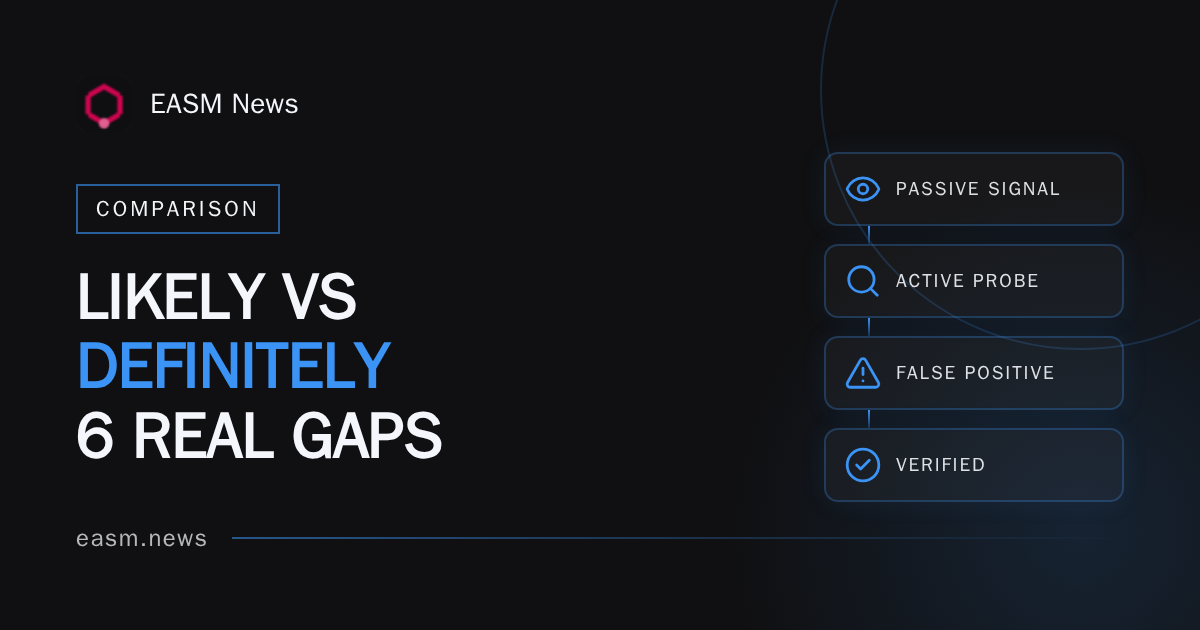
The triage order matters more than the tooling. Passive signal raises a candidate. An ownership check confirms it is yours. Active verification promotes it to a finding. Only findings get a change ticket. Candidates get a confidence level and a review date, and they stay in the candidate queue until something moves them.
Build suppression and ageing rules on day one, or the same inferred banner will re-alert every morning and the queue will be ignored by March. Suppress by asset plus signature plus a stated reason, with an expiry, so a suppression rewritten after a rebuild does not silently persist for two years. Re-raise on change: new certificate, new header, new IP, new open port.
External monitoring and internal vulnerability management are complementary controls, not substitutes, and the boundary between where each one stops is worth drawing explicitly in your own documentation. Agent-based tooling sees inside hosts it knows about. External observation sees hosts nobody told the agent fleet about. Each covers the other’s blind spot.
One worry comes up in nearly every procurement conversation, so it is worth answering plainly: reading public certificate logs, DNS records and response headers does not exploit anything and does not make your organisation more interesting to attackers. Those records are already public and already being read by people who do not ask permission. You are simply catching up.
The Short Version
- Passive external detection reads public artefacts and infers; active testing sends traffic and proves. The honest passive output is a candidate with a confidence level.
- Back-ported distribution patches are the main cause of passive false positives, because the version string stays put after the fix lands.
- Ownership, not appetite, decides whether you may probe. Unverified or third-party hosts stay passive-only until you have written authorisation.
- Passive wins on timing, because certificate transparency surfaces a new subdomain in hours while a quarterly scan misses it for weeks.
- Active wins on evidence, reachability and anything a change board, auditor or insurer has to sign off.
- Dangling DNS, exposed admin pages and certificate sprawl fall outside the CVE model and need judgement rather than a signature match.
Frequently Asked Questions
What is the difference between passive and active vulnerability detection?
Passive detection observes information that already exists about your estate, such as certificate transparency entries, DNS records, response headers and TLS fingerprints, and infers what software is probably running. Active detection sends deliberate requests to a host to confirm a specific condition. One produces a likely answer, the other produces a demonstrated one.
Can passive detection confirm a system is vulnerable?
No. It can place a host on a ranked list of likely affected candidates, which is genuinely useful for prioritisation, but the result remains an inference rather than a confirmed fact. Confirmation requires an authenticated check or an active probe against that specific host.
Is active vulnerability scanning legal on assets you do not own?
In the UK, unauthorised access to computer material is an offence under the Computer Misuse Act 1990, and that covers probing systems you do not control without permission. Get written authorisation from the party that owns the asset, with scope, timing and contacts recorded. If you cannot obtain it, limit yourself to passive observation of public records.
Why does passive detection flag patched servers as vulnerable?
Because Debian, Ubuntu and Red Hat back-port security fixes into the version they ship, patching the defect while leaving the advertised version number unchanged. A banner-based lookup sees the old number and matches the CVE. Checking the package changelog or running an authenticated check resolves it.
Do you need both passive and active detection, or will one do?
Most organisations with any meaningful internet-facing estate need both, because passive vs active vulnerability detection is a question of sequence rather than preference: passive continuously tells you what has appeared and what might be affected, active confirms the subset you own and can test. If you are choosing an order to build in, start with continuous external observation, then add verification, and read more on why a point-in-time scan leaves gaps before you set your cadence.