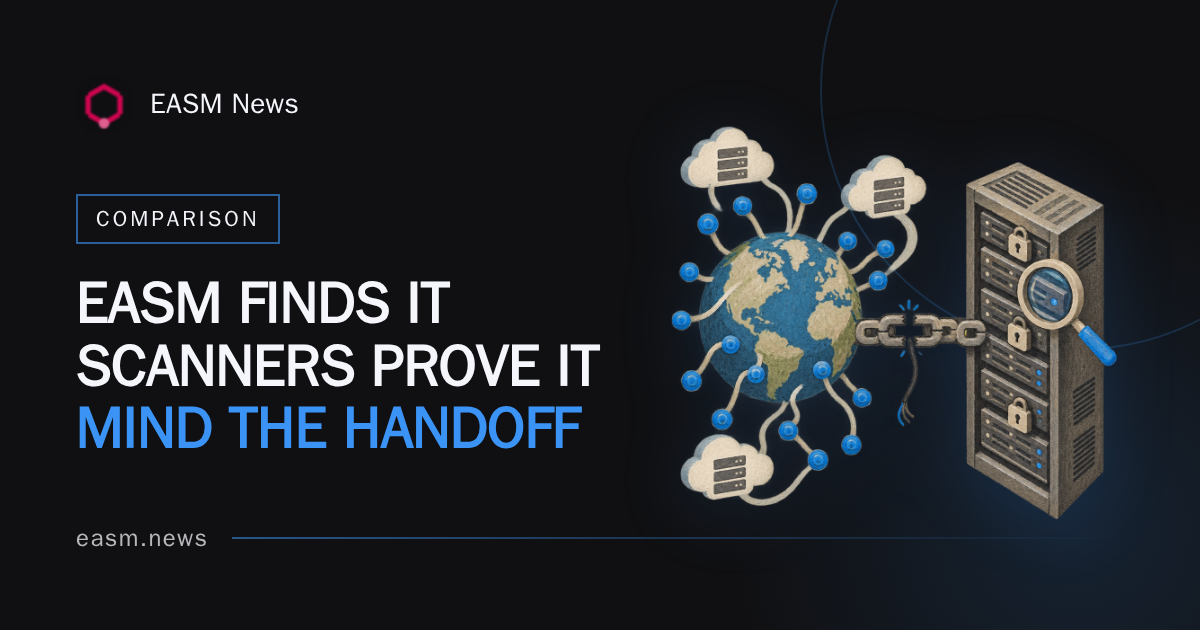
EASM vs vulnerability management is easiest to understand through a scenario rather than a feature table. A security manager runs Qualys across three /24 ranges, patches to a 14 day SLA, and has the closure evidence to prove it. Then a certificate transparency entry surfaces a hostname nobody recognises: a staging environment from a project that shipped two years ago, with an administrative login page answering on the public internet. The scanner never touched it. Its IP was never added to the scope list, so it never appeared in a report, and the absence of a finding read as the absence of a problem.
That is the seam this article is about. Most comparisons of EASM vs vulnerability management arrive at the same tidy conclusion: one discovers, one assesses, buy both. True, and not very useful. The interesting question is where each programme stops producing output you can act on, and what happens to the findings that land in the space between them.
What each programme actually owns
Vulnerability management is depth on a known list. Authenticated scans, agents, package-level accuracy, a patch SLA, a re-test and a closure record. It will tell you that a host runs OpenSSL 1.1.1k and that the distribution has back-ported a fix, which is the kind of precision you cannot get from the outside. All of it depends on a scope you supply: an IP range, a cloud connector, an agent deployment, a CMDB export.
External attack surface management is breadth on an unknown list. It starts from a seed, usually a domain and a company name, and expands outwards through certificate transparency logs, passive DNS, domain registration data and cloud IP space to produce a view of what is reachable, the way an attacker does: from the outside. The seed-to-inventory expansion process is well understood and not especially mysterious.
The difference in the output is blunt. Vulnerability management tells you a host definitely runs an unpatched version. External observation tells you it is likely to, inferred from a banner, a response header, a TLS fingerprint or a favicon hash. Both statements can be true about the same organisation at the same moment, because they are answering different questions about different populations of assets. Neither replaces the other. The distinction between likely affected and definitely affected is the whole discipline in one sentence.
Where vulnerability management stops
It assesses what you told it about. That is not a criticism; it is the design. But it means an asset that never reached the CMDB, never made the IP range list and never received an agent is absent from every report you have ever produced. And an empty result reads to a board as a clean result. The failure is silent, which is exactly why it survives audits.
Four things reliably push assets outside the scope list:
- Assets you do not control, where no agent can ever be installed: a supplier-hosted customer portal, a CNAME pointing at a third-party marketing platform, a campaign microsite an agency built and still hosts.
- Scope drift between quarterly reviews: a new cloud account, an acquired brand with its own registrar, a dev team standing up an environment with a public load balancer on a Friday afternoon.
- Cloud addresses that change. Scanning a static range misses anything that moved.
- Exposure that only exists from outside. Credentialed scanning from inside the network tells you little about how a service is published: a reverse proxy exposing a management path, split-horizon DNS resolving differently for the public, a redirect that lands somewhere nobody intended.
Then there is the compliance edge. Cyber Essentials requires software on internet-facing services to be updated or mitigated within 14 days of a release that fixes a vulnerability rated high or critical, as set out in the NCSC’s Cyber Essentials requirements. You cannot evidence 14 day patching for an asset that is not in your scan scope. You cannot evidence it at all, in either direction.
Where EASM stops
Discovery produces candidates, not an inventory. A certificate transparency entry proves a name was once put into a certificate. A historic DNS record proves a name once resolved. Neither proves the asset is live, that it is yours, or that it sits inside your risk boundary. Confirming ownership, liveness and business function is human work, and skipping it is how a team spends a fortnight chasing a shared host belonging to a supplier.
Attribution fails in both directions. Shared hosting, CDN front-ends and third-party SaaS tenants drag in assets you have no authority over; meanwhile, assets sitting on an unexpected registrar, in a regional cloud account, or under a brand name the acquisition never formally transferred get missed entirely. Any vendor claiming complete coverage is describing an ambition.
Passive fingerprinting has a ceiling. A back-ported version string on Debian or RHEL will look unpatched when it is not. A stripped or rewritten banner tells you nothing at all. A WAF in front of the service can mask the thing you are fingerprinting. The finding is an inference, not a confirmed fact, and it stays that way until something is actively tested or a credentialed scan reaches the host.
And the whole category is blind to anything not reachable from the internet: internal segments, endpoints, identity configuration, privilege, anything requiring a credential to assess. An external view of a flat internal network looks identical to an external view of a well-segmented one.
The findings that fall between the two
This is the gap nobody staffs, and it is more consequential than the overlap everyone argues about.
A marketing subdomain left as a CNAME to a deleted cloud storage bucket or a retired platform tenant has no version number, no CVE and no CVSS score. There is nothing to patch. Whoever registers that bucket name next can serve content on your domain, which is why dangling DNS records invite subdomain takeover. The remediation is a one-line DNS change that takes a minute and frequently waits months.
Certificate hygiene behaves the same way. Expiry dates nobody owns, wildcard sprawl that hides which hostnames are actually in use, and retired hostnames still appearing in transparency logs long after the service died. None of it is a software defect.
Exposed administrative interfaces, legacy protocols and forgotten staging environments round out the set. A Telnet service answering on the public internet is a configuration decision, not a bug.
Here is why these stall. A severity-sorted patch queue sorts by severity, and these findings have no score to sort by. CVSS v4.0, published by FIRST, scores vulnerabilities in software; it was never meant to score a pointer to nothing. So the finding arrives with no number, often no named owner, and no obvious queue. It then ages quietly while CVEs with tidy 9.8 scores get the attention.
Building the handoff: one process, two capabilities
The sequence that works is unglamorous and roughly this:
- Seed expansion produces candidates.
- A human reviews them and discards the obvious noise.
- Ownership is confirmed, or the asset is explicitly marked as someone else’s.
- Confirmed assets get an inventory record.
- Where you control the asset, an authenticated scan converts inference into fact.
- Remediation gets a stated deadline, not a status.
- A re-check proves the change landed and the exposure is actually gone.
Record enough at step four to make the handoff possible: hostname, resolved address, the service and version evidence as observed, hosting provider, business owner, date first seen and date last seen. The last two matter more than they look. They are what let you tell a genuinely new exposure from an old one you have been ignoring.
Change detection is the trigger, not the schedule. Catching an exposure the day it appears is worth more than deep scanning it three weeks later, which is the honest argument for continuous monitoring over a point-in-time assessment.
One decision to make before you buy anything: which platform holds the asset record. Running both tools without agreeing a system of record produces two tickets for the same host, and engineers learn fast to ignore whichever feed cries wolf more often. Pick one inventory. The other raises findings against it.
Prioritisation: whose queue does it go in?
Ranking external findings by CVSS alone misfires, because the base score knows nothing about whether the service is reachable, whether authentication sits in front of it, whether the flaw is being exploited in the wild, or whether the host is a brochure site or the payments gateway. A medium-severity flaw on an unauthenticated admin panel facing the internet outranks a high-severity one behind a VPN. Weigh reachability, authentication, known exploitation and business function alongside the score.
Agree routing rules in advance, while nobody is under pressure:
- Patchable software defects go to the vulnerability management queue, with the usual SLA.
- DNS and certificate problems go to whoever controls the zone, which is often not the security team.
- Assets nobody will claim go to a decommissioning decision, with a date.
Suppress noise with an expiry, never permanently. A finding dismissed in March should reappear in September and be looked at again, because the reason it was dismissed may have expired with it.
Two myths worth killing while you are at it. Passive external observation does not exploit systems; reading a banner is not an attack, and it has not tested the flaw. And being enumerated from the outside does not make an organisation a target. Everyone with a public IP is already enumerated continuously; the only question is whether you see what they see.
Deciding where your next pound goes without paying twice
Run the overlap test honestly. On one side, list what your current scanner already does with the ranges it knows about: depth, authentication, closure evidence. On the other, list what it has never been told about: SaaS tenants, agency-hosted sites, the subsidiary’s domains, cloud accounts opened on a departmental card. If the second list is short and provably complete, your money belongs in scanning depth. If you cannot prove it is complete, it is not.
Ask both vendors the same five questions: how is scope defined and expanded, how fresh is the data and what triggers a re-check, what evidence supports each finding, what happens to non-CVE issues like dangling records and certificate expiry, and does active verification exist as an option. The evaluation checklist for EASM products goes further on this, because the market is crowded and loud.
Workflow fit beats feature count. Findings that do not arrive in the ticketing system your engineers already open every morning do not get fixed, however elegant the dashboard.
Sometimes the answer is neither tool yet. If you do not know the size of the problem, a free discovery pass using public sources and a week of honest inventory work will tell you more about which budget line to argue for than any demo.
The Short Version
- Vulnerability management is only as good as the scope handed to it, and a missing asset produces an empty result that reads as a clean one.
- Discovery output is a list of candidates. Ownership, liveness and business function are confirmed by people, not by the tool.
- Passive observation gives you likely affected; authenticated or active testing gives you definitely affected. Use the inference to target the verification.
- Non-CVE findings, dangling DNS, certificate decay and exposed admin interfaces, have no score and no patch, so they need their own route to an owner.
- Decide which platform is the system of record before you run both, or you will train your engineers to ignore one feed.
- Frameworks like Cyber Essentials and ISO 27001 assume an accurate asset list exists before assessment starts. That assumption is usually the weakest part of the programme.
Frequently Asked Questions
Is EASM a replacement for vulnerability management?
No. External attack surface management finds and characterises assets you did not know were exposed; vulnerability management assesses assets you already know about, in depth, usually with credentials or an agent. Dropping authenticated scanning in favour of outside-in observation would trade package-level accuracy for inference. They answer different questions about different populations of assets.
What can EASM see that a vulnerability scanner cannot?
Assets that were never in the scan scope: agency-built microsites, supplier-hosted portals, cloud resources spun up outside the known ranges, and hostnames that only ever appeared in a certificate transparency log. It also surfaces issues that are not software defects at all, such as a CNAME pointing at a decommissioned resource or a wildcard certificate covering hostnames nobody can account for.
Who should own external findings that have no CVE, such as dangling DNS records or expired certificates?
Whoever controls the DNS zone or the certificate, which in many organisations is infrastructure or platform engineering rather than security. The practical move is to agree the routing before the first finding lands, and to give these items a deadline in the same tracker as patching work, since they will never surface in a severity-sorted patch queue on their own.
How often should external assets be checked compared with internal vulnerability scans?
External exposure changes whenever a DNS record, certificate or cloud resource changes, so detection ideally runs continuously or at least daily, with the goal of catching new exposure quickly rather than deeply. Internal authenticated scanning can sensibly run weekly or monthly, since the host population is more stable and the depth takes longer to process.
Do we still need EASM if our vulnerability scanner already covers our public IP ranges?
Possibly not, if you can prove the range list is complete and nothing of yours is hosted outside it. That proof is the hard part: SaaS tenants, acquired brands, agency hosting and departmental cloud accounts rarely appear on an IP range list. Test the assumption with a discovery pass before deciding you are covered.