External Attack Surface Management is one of those phrases that sounds more complicated than the idea behind it. Stripped down, it answers a single question that most organisations cannot answer confidently: what do we expose to the internet, and what is wrong with it? The National Cyber Security Centre defines EASM as the process of identifying, monitoring and reducing vulnerabilities in the assets that are reachable from the internet. That is the whole discipline in one sentence.
The reason it exists is that the honest answer to that question is usually “we are not sure”. Organisations accumulate internet-facing things faster than they document them: a marketing microsite spun up for a campaign, a test server that was never taken down, a subdomain pointing at a cloud service nobody uses any more, a supplier’s widget embedded years ago. Each is a door, and the ones nobody remembers are the ones left unlocked.
The Attacker’s View
What makes EASM distinctive is the perspective it takes. It looks at your organisation the way an attacker does: from the outside, with no inside knowledge, no asset register and no assumptions. An attacker planning against you does not start with your documentation. They start by mapping everything of yours they can find, and they are patient about it. EASM is the attempt to run that same reconnaissance against yourself, continuously, and to see what they would see before they act on it.
This is why an EASM view so often surprises the people who commission it. The first scan routinely turns up assets the security team did not know existed, owned by parts of the business they were never told about. Finding those is frequently worth the exercise on its own, before any vulnerability is even considered.
What It Actually Does
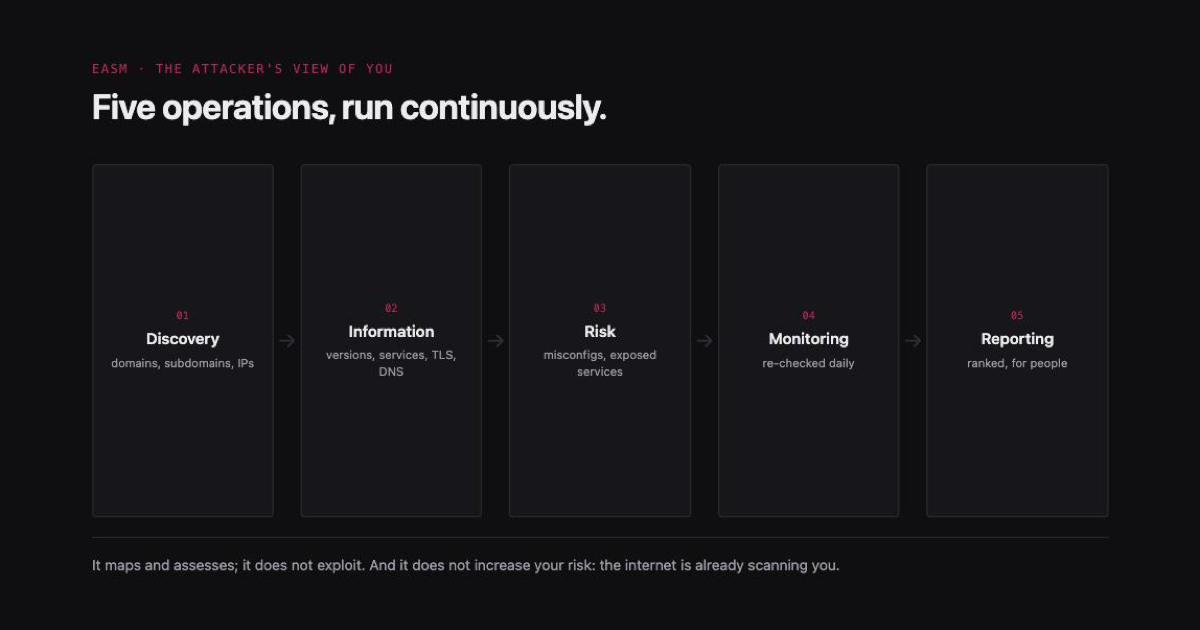
The NCSC breaks the work into five operations, and they make a useful mental model. Discovery finds the domains, subdomains and IP addresses that belong to you. Information gathering works out what each asset is: the web server and its version, the services running, the TLS certificates, the DNS configuration. Risk identification flags what looks wrong: outdated software, exposed services that should not be public, weak email security, misconfigurations. Monitoring repeats all of this on a schedule, because the surface changes daily. Reporting turns the result into something a team can act on and a board can understand.
Notice what is not on that list: exploitation. EASM maps and assesses; it does not break in. That distinction matters and is the source of a lot of confusion, which later articles here will pull apart.
A Reassurance Worth Stating
A common worry is that scanning your own attack surface somehow increases your risk, as though shining a light on the assets makes them more visible to attackers. The NCSC addresses this directly: using an EASM product does not increase the risk to your online services, because internet-wide scanning is happening continuously anyway. Everyone can already see your external surface. EASM simply lets you see it too. The only real caution is operational: some products offer active vulnerability assessment as an add-on, and that can trip intrusion detection, so it is worth coordinating with your own security team before switching it on.
The Short Version
External Attack Surface Management is the practice of looking at your internet-facing assets the way an attacker would, continuously, and fixing what you find. It discovers what you expose, works out what each thing is, flags what is wrong, and keeps watching. It does not exploit anything, and it does not make you more of a target. Its first and often biggest value is simply telling you what you did not know you had.