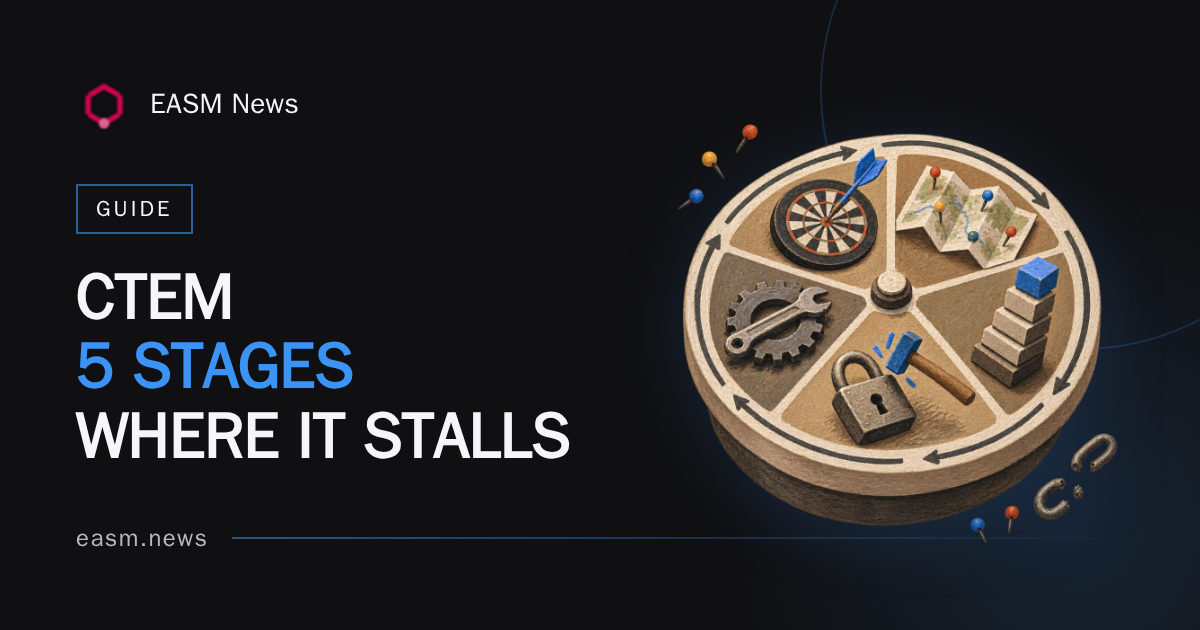
Continuous threat exposure management is usually explained as five words in a circle, and that diagram is where most articles stop. The five stages are real, and they are useful, but the diagram hides the part that decides whether a programme works: what each stage demands of you when the estate in question is the one visible from the public internet, where you do not control what gets published and you rarely know the full list.
Gartner coined the term in 2022 to describe a repeating cycle rather than a tool. That distinction matters more than it sounds. This piece walks the five stages from the outside in, names where programmes stall, and says plainly which stage is quietly the hardest.
What Continuous Threat Exposure Management Actually Changes
The old pattern is familiar. A scan runs quarterly, produces a ranked list of several thousand items, and the list is never finished before the next scan replaces it. CTEM replaces that with a question asked repeatedly: of everything exposed, which of these could a real attacker actually use against this organisation, this week?
Note the word exposure rather than vulnerability. The widening is deliberate. A misconfigured storage bucket has no CVE. Neither does an administration console published to the open internet, a certificate that expired on a login path, an SPF record that never got tightened, or a DNS entry pointing at a cloud resource that was deleted eighteen months ago. These are exposures, they are routinely the ones attackers reach for first, and vulnerability scoring systems rank them at nothing because there is nothing to score.
Two words in the name carry the weight. Continuous means change detection rather than a periodic photograph. Management means an owned programme with a cycle, a cadence and someone accountable, which is the part a purchase order cannot deliver.
Be honest about the market as well. CTEM is a programme model, not a product category. No single vendor covers all five stages credibly, and anyone claiming otherwise is selling you a discovery tool with a workflow module bolted on. Several of our technical explainers cover the component parts in more detail.
Stage 1: Scoping, and Why Most Teams Scope Too Narrowly
Scoping means choosing a slice of the business worth defending first, usually by revenue, regulatory obligation or blast radius. You do not attempt the whole estate in cycle one. That is sound advice, and it contains a trap.
On the external surface you cannot scope what you have not discovered. Business-criticality scoping assumes a known inventory, and the known inventory is exactly what external attack surface management exists to challenge. The honest sequence for a first cycle inverts the textbook: run a light discovery pass, see what actually exists, then scope. Otherwise the programme spends six months hardening the three systems everybody already knew about while the attacker works on the fourth.
Starting externally has a second advantage that gets undersold. The internet-facing estate is the only scope you can define without internal cooperation. No agent deployment, no CMDB project, no negotiation with the cloud team. It is also the scope an attacker would recognise, because it is assembled the way an attacker does: from the outside.
The asset register makes a poor boundary. It records what was approved, not what is live. Campaign microsites, acquired brands, departmental cloud accounts opened on a corporate card, staging environments that outlived their project: none of them went through the approval process that populates the register.
The output of this stage is modest and specific. A seed list of domains, brand names, IP ranges and cloud tenancies, with a named human against each. Not a document. A list someone maintains.
Stage 2: Discovery That Finds the Estate Nobody Logged
Outside-in discovery starts from the seeds and expands. Certificate transparency logs reveal hostnames that were never meant to be public, because every publicly trusted certificate is published by design. DNS records, including historic entries, show where names used to point. WHOIS and registration data link domains to the same registrant. Reverse lookups across IP space surface neighbours on shared infrastructure. The mechanics are covered at length in our piece on how discovery reaches the assets you forgot.
Here is the part that separates a usable discovery stage from a list that gets ignored: discovery returns candidates, not an inventory. A hostname in a certificate log may belong to a partner, a reseller, a decommissioned service, or nobody at all. It may resolve to an IP that someone else now owns. Attribution is a decision, and the decision has to be recorded with its reasoning, because the same candidate will reappear next month and you do not want to relitigate it.
Consider the acquisition case, which recurs constantly. A company buys a smaller competitor, migrates the main website to the parent brand, and declares the integration finished. Three years later, certificate logs still show live subdomains on the old domain, running a content management system that stopped receiving patches two major versions ago. It appears in nobody’s register because the register belonged to a company that no longer files accounts.
What you need out of this stage is not a hostname list. It is ownership, first-seen date and current live status for every claimed asset, because every later stage depends on those three fields and none of them can be reconstructed afterwards.
Stage 3: Prioritisation Beyond the CVSS Score
Sorting by severity alone rebuilds the infinite backlog that CTEM exists to escape. Take two findings. A CVSS 9.8 on an internal system reachable only through the VPN, with MFA in front of it. A CVSS 5.3 on an unauthenticated admin console answering on a public IP. Severity scoring ranks those one way. Exposure context ranks them the other way, and exposure context is right.
The factors that should move a finding up or down the list are reachability from the internet, whether the flaw is being exploited in the wild, the business criticality of what sits behind the service, and how quickly the asset could simply be removed.
Whole classes of urgent finding carry no CVE. A dangling CNAME pointing at a deleted cloud resource is the clearest example: the bucket is gone, the record remains, and anyone can claim the free resource name and serve content from a subdomain carrying your brand, your cookies and your reputation. We have written separately on the dangling DNS problem and how takeovers actually happen. An expired certificate on a payment or login path is another. A management interface published to the open internet is a third. None of these is exotic. A prioritisation engine built purely on CVSS scores all three at zero.
One more thing worth saying bluntly. The fastest remediation is frequently deletion. An asset that should not exist is a one-line change, not a patch cycle, not a regression test, not a change window.
Stage 4: Validation, the Stage Programmes Quietly Skip
This is the hardest stage and the one most often dropped, because it costs time and it costs authorisation.
The distinction that defines it: passive external observation tells you a system is likely affected, inferred from a banner, a response header, a fingerprint or a version string that may well be wrong. Active testing establishes that it definitely is. The gap between those two words is where programme credibility lives, and we have unpacked it further in likely versus definitely.
Likely findings are not worthless. They are the correct trigger for an investigation. They are the wrong thing to send to an infrastructure team phrased as a confirmed fault. Do that once, get caught out by a false positive, and the team discounts every report you send for the next year. That is how exposure programmes die: not from a breach, but from being ignored.
Validation also reduces work rather than adding it, which surprises people. Confirming or dismissing a finding once stops it reappearing in every weekly report forever. Options sit on a spectrum: authorised active scanning against your own estate, penetration testing for the findings that justify it, and the cheapest check of all, verifying whether the exposure is genuinely reachable or quietly blocked by a WAF or upstream filter.
And the myth needs killing. Continuous exposure management does not mean continuously attacking your own systems. Discovery and monitoring of your external estate is passive observation of what is already published to the internet. It exploits nothing. It does not raise your profile with attackers, who are enumerating the same certificate logs you are, and who started earlier.
Stage 5: Mobilisation, or Why Findings Sit Open for Months
Mobilisation is the organisational stage, and it is where technical programmes meet their actual constraint. Findings go to the team that can act, with an agreed service level and a defined route for disputing a finding. Without the dispute route, disagreements become silence.
External findings carry a particular handover problem. The owner of a forgotten subdomain is often a marketing agency whose contract ended, a former supplier, or a team that was reorganised out of existence. The technical fix takes thirty seconds. Finding someone willing to authorise deleting a DNS record for a site whose original owner left in 2021 takes three weeks. Build that authorisation path while things are calm, not during the incident.
Treat workflow integration as a selection criterion rather than a nice extra. A finding that arrives as a PDF attachment to a monthly email will not get fixed. A finding that arrives as a ticket in the queue the team already works, with the asset, the owner and the evidence attached, has a chance.
Then close the loop. Re-check after remediation and treat the re-check as the evidence. A closed ticket is a claim about work, not proof that the exposure is gone.
Making the Cycle Continuous Without Drowning the Team
Cadence is two decisions, not one. Continuous change detection on the external estate answers “what is different since yesterday”. Scheduled deeper assessment answers “how bad is what we already know about”. Running only the first gives you a stream of events with no depth. Running only the second gives you a snapshot of a river.
Noise control that works in practice: alert on change and on new exposure classes, not on the continued existence of a known state. Suppression rules should carry expiry dates, because a suppression without an expiry is a decision to never look again.
On tooling, the honest division of labour is this. External attack surface management supplies the outside-in view and the discovery stage. Vulnerability management goes deep on assets you already know you own. Internal tooling covers everything the internet cannot see. None of the three replaces the others, and buying the first while cancelling the second is a mistake we see repeatedly.
UK regulation is moving the same way. The Cyber Security and Resilience Bill, introduced to Parliament in late 2025 and still progressing at the time of writing, alongside NCSC vulnerability management guidance, pushes organisations towards knowing their internet-facing estate continuously rather than attesting to it once a year. That maps onto the CTEM cycle almost exactly.
Before buying anything, ask five questions: which of the five stages does this genuinely cover, how fresh is the data and how is freshness measured, how is prioritisation calculated and can you see the logic, what does it find beyond CVEs, and how does it hand a finding to the person who fixes it. Our practical evaluation checklist goes further on the procurement side.
One note on the evidence base. Gartner’s 2023 forecast was that organisations prioritising security investment through a continuous exposure management programme would be three times less likely to suffer a breach by 2026. That is a projection from an analyst firm, not a measured outcome, and it should be read so.
The Short Version
- CTEM is a five-stage repeating cycle: scoping, discovery, prioritisation, validation, mobilisation. It is a programme model, not a product you can buy whole.
- On the external surface, run a light discovery pass before scoping. You cannot prioritise an estate you have not found.
- Discovery produces candidates. Record the attribution decision and the reason, or the same arguments repeat every month.
- Many of the most urgent external findings carry no CVE at all. CVSS-only prioritisation ranks them at zero.
- Validation is the stage most programmes skip, and skipping it costs credibility. Keep “likely”and “definitely”visibly separate.
- For forgotten assets, deletion usually beats patching. The blocker is authorisation, not engineering.
Frequently Asked Questions
What are the five stages of continuous threat exposure management?
Scoping, discovery, prioritisation, validation and mobilisation, as set out in the framework Gartner published in 2022. Scoping chooses what to defend first, discovery finds what exists, prioritisation ranks by real-world exposure rather than severity alone, validation establishes whether a finding is confirmed or inferred, and mobilisation gets it fixed by someone with the authority to act.
Is continuous threat exposure management a product or a programme?
A programme. Products support individual stages, and several cover two or three reasonably well, but no vendor delivers the whole cycle because mobilisation depends on your internal ownership and approval structures. Treat any product marketed as complete CTEM with scepticism.
How is CTEM different from vulnerability management?
Vulnerability management works from a known asset list and finds flaws with identifiers on them. CTEM starts by questioning whether the asset list is complete, and counts exposures that have no identifier at all: misconfigurations, exposed interfaces, certificate problems and dangling DNS records. The two are complementary rather than competing.
Where does external attack surface management fit into CTEM?
Primarily in discovery, and heavily in prioritisation. External attack surface management assembles the internet-facing view from outside, which is the input scoping needs and the context that makes prioritisation meaningful. It contributes to validation only up to the point of inference, so active confirmation generally sits with other tooling or with testing.
How often should the CTEM cycle run?
Change detection on the external estate should be continuous or close to daily, because DNS records, certificates and cloud services change without anyone filing a ticket. Deeper assessment and re-scoping suit a quarterly rhythm for most mid-sized organisations. The cycle you can actually sustain beats the cycle that looks better on a slide.